
The Adapt Again System™
The Framework
What is the organization actually trying to build?
Transformation Capability is an organization’s repeatable ability to transform from within —sensing change and friction, learning from the work, and continuously redesigning the boundaries between people, technology and the operating system to create and sustain better outcomes as conditions change, without depending on a recurring, disruptive transformation program.
The Adapt Again System™ is the practitioner framework and mechanism being applied. Transformation Capability is the organizational ability being developed, retained, renewed, measured and exercised.
TRANSFORMATION INFRASTRUCTURE ≠ TRANSFORMATION CAPABILITY
Formal structures, forums, roles, tools and documentation may support capability. They do not prove that people can explore, learn, decide, act, absorb what works and revise the system when conditions change.

The Mechanism
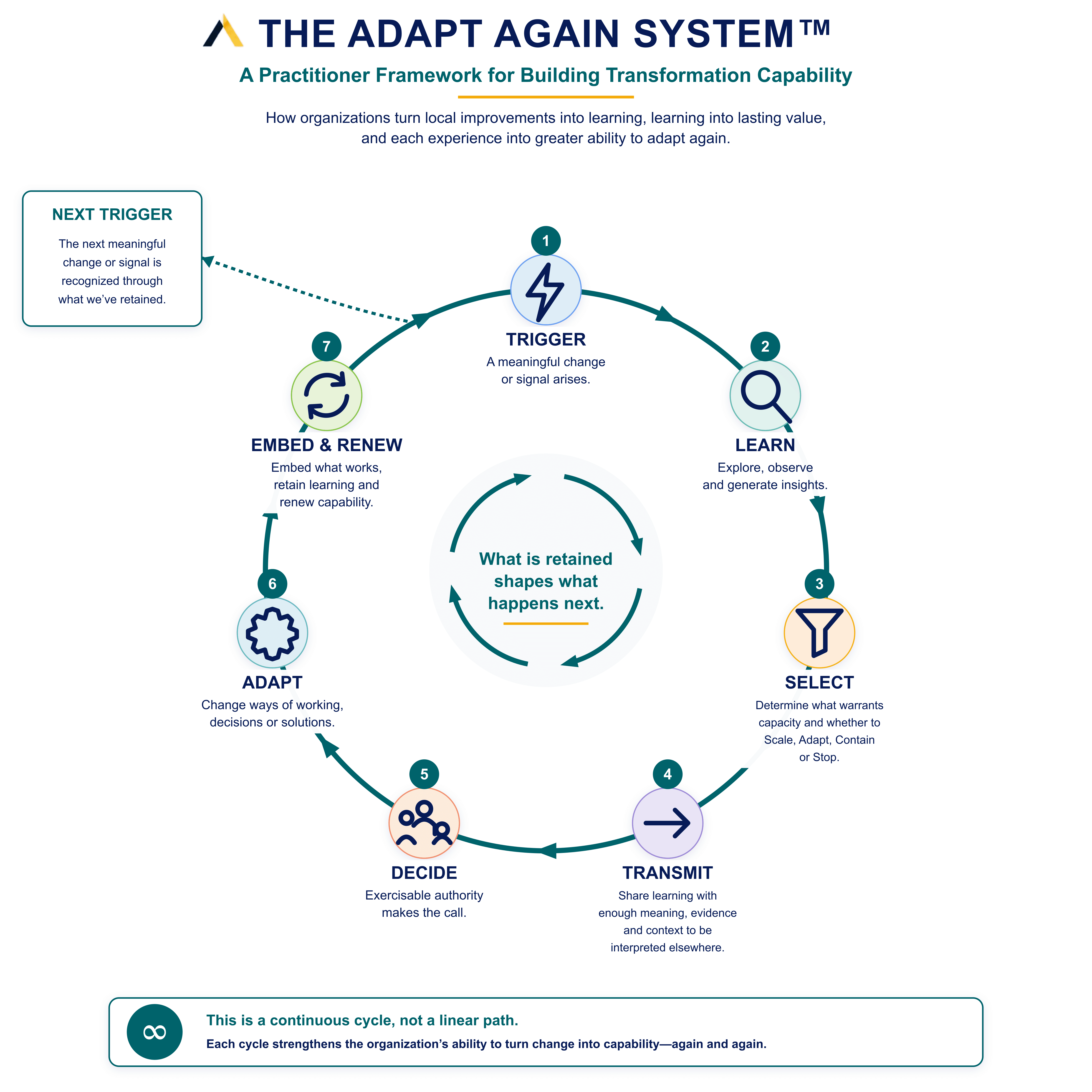
Trigger: A meaningful change, opportunity, friction, failure, evidence or local improvement creates reason to investigate and adapt. AI may be a trigger; the mechanism is not defined around AI.
Learn: Understand what reality is teaching by separating the visible event or solution from the underlying learning: what changed, why, which assumption moved, which constraint mattered and what may be context-specific.
Select: Decide which local improvements or learning warrant limited organizational capacity, then determine what should happen to the improvement: Scale, Adapt, Contain or Stop.
Transmit: Move selected learning beyond its origin with enough meaning, evidence and context for others to interpret and apply it appropriately. Translation or adaptation may be necessary across boundaries.
Decide: Determine what should change because of the learning and ensure the decision reaches someone with sufficient exercisable authority to act.
Adapt: Change consequential parts of the surrounding organizational system - work, decisions, governance, roles, incentives, measures, funding, technology, structures or operating arrangements, while preserving what remains valuable.
Embed & Renew: Make useful adaptation durable, meaningfully owned and observable while keeping it challengeable and revisable as evidence and conditions change. Let the result inform the next cycle.

Every improvement deserves learning. Not every improvement deserves scaling. Learning has not been transmitted merely because it has been shared.

A decision has not done its job merely because it was formally made. It must be capable of changing the relevant organizational system.
Conditions
Enough safety to explore
Enough boundaries and guardrails to act responsibly
Enough feedback to learn
Enough capacity to absorb and build on that learning
The word ENOUGH matters. Adaptation does not wait for a perfect culture or structure. It needs conditions sufficiently functional for responsible exploration, learning and action.
Stewardship

Learning does not move through an organization by itself. Someone must have sufficient responsibility and capacity to notice what has been learned, help it cross organizational boundaries, connect it to people able to act, and follow what happens next.
Continue Exploring